|

|
|

|

|
The Postmodern Paradox
John Haberin New York City
Cette vie est un hôpital où chaque malade est possedé du désir de changer de lit.
— Charles Baudelaire, "Anywhere Out of This World"
Keeping Modernism Alive
Modernism demanded one thing: make it new. If I discard it, I have to find something else, something new. And so I am modernist. If I discard the aim of making it new, then I must do something other than Modernism. But that means something new.
A cornerstone of modern philosophy was laid by a mathematician, Kurt Gödel. He saw disaster lurking wherever logicians build a system, even so innocuous a game as arithmetic. Eventually, the system produces a statement with the irritating shape of "This is not true!" If it is true, it can only be false; if it is false, then it is true. And it will never cease to recur, as long as one has the power to think and to construct. 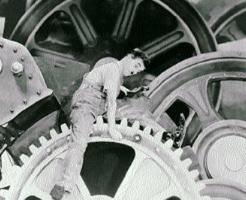
Postmodernism, too, can no more exist than it can be avoided. And that is precisely what makes it modern. More than any condition or any arts that Baudelaire could foresee, Postmodernism is "anywhere out of this world." Instead of the postmodern condition, one ought to speak of a postmodern paradox. I shall argue that Postmodernism is more than talk at the expense of art. For all its silliness, it is part of a critical practice that reminds you and me why Modernism and contemporary art still matter.
Baudelaire the postmodern
Start with a poet, a tireless defender of avant-garde painting: "this life," this modern life, "is a hospital where each patient is obsessed with the desire to change beds." Actually, Charles Baudelaire preceded Modernism, but he did not require the gift of prophecy. It is not just his love of Edouard Manet's generation and a new French taste. No, he breathed the modern condition and its artistic form in the night air of the city.
You may be suspicious of Postmodernism. Fair enough: if there is a postmodern condition, it cannot even be stated consistently much less cured. Like a right-wing fantasy of the welfare state, it is a hospital where the beds must remain empty.
No wonder that proponents of a new cultural era sound so otherworldly. Think of fierce post–Cold War ideologues reveling in The End of Ideology or J.-F. Lyotard, the lively philosopher of the French left, author of The Postmodern Condition. Think of Jean Baudrillard, who has traced an "objective profile of America" in Disneyland. And sure, go ahead, think of "artspeak." They are all full of prophecies of an era without a past—the end of history or the information age.
Thanks to them, modernity suddenly means not the fierce urgency of now, but urban life in the 1940s. "Modern times" are around now only as the title of a wistful best-seller, and forget about Baudelaire's deserted streets. Paris at night calls up endless rebroadcasts of Gigi. I'm glad I'm not modern anymore.
Postmodernism has even turned Baudelaire back into a prophet: the next, and last, poem in that book is "Assomons les Pauvres!" Beat up on the poor! It sounds much like the demand of politicians today.
If one cannot define Postmodernism, one can still ask why it has to be invoked. In the process, one can ask what keeps Modernism alive not just despite its critics, but even because of them. One can ask what makes many so uneasy with the label modern—or nostalgic for it. One has to talk not about the Postmodernism condition, but also about how Modernism is perceived at the millenium. As you will see, it may not look so bad after all.
Modernism's missing heritage
If Modernism no longer fits, for art or society, then why? Does it survive only as "zombie formalism," with all styles available at once? If it is dead, then who had means, motive, and opportunity? The deed must have taken place during a struggle. And Postmodernism is still struggling over the heritage of Modernism, only the more it struggles, the more it helps keeps Modernism alive.
The fight is still on, but the fighters are exhausted or reeling. Today an art critic, T. J. Clark, can write that Abstract Expressionism may not be all bad, provided one recognizes that its finest exponent is . . . Asger Jorn. Half of me hopes you said, "Who?" Either way, you get the joke—and it may not be at the expense of Modernism.
So what was modernity, and how does it reemerge each time it is pronounced dead? Consider what its critics think has been going on for the last century or so. I shall take "fine art" as my example because I sometimes pretend to miss it.
First, modern art became an institution, like that hospital again. It began with more than enough commitments—to the newly independent art market, to the male psyche. In any event, it had to answer to academic politics and the growing dominance of American culture. It had to serve the practical needs of its students. It had to take on the factory standards of Minimalism and the profound influence of its greatest writers.
Second, modern art therefore became identified with formalism, the painted edge with the cutting edge, even as the limiting definition paradoxically suggests only a moment in time. For Clement Greenberg, the best work reflected on the making of art and on art's place in society. To many, that came to mean an art turned back onto itself. In the 1970s, as many artists rebelled against color-field abstraction, they appeared to be denying modern art itself.
Third, the avant-garde started to carry around the baggage of a promise, like the first President Bush on taxes. To Brecht, art remade society; to Futurism, it was the soul of a new machine; to one side of Surrealism, the unconscious liberates. Griselda Pollock, the feminist critic, has called it all "a subculture . . . a gamble." Yet utopia was not arriving. As modern art became accepted into great museums, it stayed excluded by nearly everyone else. Modernism seemed in trouble.
Fourth, Modernism gave credence to the creative individual forced to be in an avant-garde. It might sustain a Vincent van Gogh in his passion for drawing—or allow an Abstract Expressionist an existential crisis. Yet Minimalism and Andy Warhol left art eerily impersonal, reproducible, even hypothetical. Meanwhile, the heroes of Modernism, such as Picasso or indeed Andy Warhol, looked more and more like a sad train of white men fixated on high art. Their dedication was now taken as an emblem of privilege; their obsession made their art a fetish, a token of their sexual conquests.
Fifth, Modernism loved irony and self-reflection. It saw contradictions lurking in every gesture, in the words of every poem. Now irony was losing its edge, like the rounded corners of a TV screen, and talk of the contradictions in capitalism grew quaint. Poets may still juxtapose opposites, but not to release fresh, ironic meanings. Rather, they suggest the limitations of meaning altogether. At best, like trees in a poem by John Ashbery, "Arranging by chance / To meet . . . / their merely being there / Means something."
Sixth, Modernism calls to mind struggling masses and urban streets. It brought an explosion of American power and creativity. Its stunning concentrations of wealth, machinery, and energy were matched by equally penetrating images. Yet, somewhere, society lost its center. Modernism may now be defeated by a suburban sprawl and the anonymous bytes of computer networks.
Modernity fights back
Fair enough, but when exactly did it die? Postmodernism may have come about more than thirty years ago in performance art. It might have begun with Neo-Expressionism a decade later. Or it might have taken the pop-culture appropriations and political dogmatism of the last gallery you visited. Maybe it still awaits technological change as a triumphant end to the crises of capitalism.
In any case, its fans say, Postmodernism hits my six points hard. It distrusts art institutions and formalism. It will not try to escape from society, but it not be caught up in an old culture. It takes its vocabulary from movies, television, the computer, the Internet, and the Xerox machine.
Yet consider how little critics have learned from their criticism of modernity and how hard it is for them to stop. Suppose that Modernism really was about one thing: make it new! Then how can artists have outgrown it? Take each criticism in turn.
First, Modernism largely preceded the institutions that it created. Its supposed dominance came in face of barriers that are unthinkable today. One no longer can imagine a division between gallery and museum, between loft district and shopping mall. Now a critical trend such as cultural studies or The Anti-Esthetic earns a spacious shelf in profitable bookstores. On the other hand, the modernist distrust of institutions lives on. Only in neoconservative fantasies does a scholarly avant-garde control the minds and purses of America.
Second, formalism should be seen as just part of a lively culture. This century was big enough to contain Dada, and the newest art has well been termed neo-Dada. (It sometimes looks more like a neo-WPA.) Besides, art will continue to cherish its means. As Nancy Fraser points out with regard to language-centered art and philosophy, to focus on a process is to draw attention to norms, to values. Art will thus always draw content from its formal devices. Creators who cannot are simply glib.
Third, utopias were scary enough in an age of Hitler and Stalin faced with abstraction, long before "the end of history." Conversely, they are still relevant. They amount simply to visions of the future, which often must precede change in the present—even when the visions, like the TWA terminal by Eero Saarinen, are abandoned. Some artists expand by visions, some work quite well without them (thank you), and plenty simply capitulate to the mass market.
Fourth, Modernism already probed the individual to death—but hardly as a repeat of Romanticism's inward gaze, as it has appeared to such historians as Robert Rosenblum. In it, impersonal imagery, personal creativity, and social criticism collided productively. Baudelaire already felt caught amid two muses—la muse vénale and la muse moine—venal or monastic. He could find health in neither one, which is why he precedes them both with la muse malade. Some artists have always been celebrities and misogynists, but only now is art supposed to be about star status.
Fifth, the distinctions that Postmodernism demands are often too theoretical for words. Just try to remember when a work embodies irony or ridicule, contradiction or juxtaposition. Try to decide when art gave up the Bible for the movies: at the time, just which of the two was popular culture? Despite the rebellion against institutions, these arguments have the air of celebrating academic jargon. Even worse, they may turn out to be prophetic—Wayne's World as a model for art and society.
Finally, modern art always acknowledged strange mass media, as in Picasso's first newsprint collage. Besides, technoculture does not necessarily sound liberating—or even new. It may just mark a further, incremental concentration of corporate influence, as Fredric Jameson has argued. You may indeed be able to read this essay again next year online—depending on how the Justice Department settles accounts with Microsoft.
Lost causes and found values
My defenses of Modernism may even convince me, but they only seem to escape the postmodern paradox. They are an odd jumble. Some of them really agree that Postmodernism is new. They just add a protest against its insincerity. My other arguments trace every crisis and compromise back to Modernism—but that places the whole idea of the new doubly in doubt. Even Jameson denies the promise of revolutionary change.
In other words, Modernism is over, and newness is glib; Modernism is still around, but it has lost its novelty. It is hard to know which admission is most damaging to a modernist. Yet both sides of the paradox give the modernist critique renewed value. It becomes the lost cause that refuses to crawl away in defeat.
Deconstruction, the first great impetus for a shift from philosophy to cultural studies, shows the perplexity—and it was never, ever about cheap, dismissive identity politics. It tried to outsmart the paradox by undermining sure conclusions. It struck a harsh blow against the great modern systems, like an official greeter of the apocalypse. Before long, however, it came to seem burdened with the discourse of Modernism.
Its roots were in structuralism, and it rebelled against that theory's tidy methods. It exploited postmodern eclecticism, in gaudy architecture and dizzying play with philosophy's metaphors. Yet it remained mostly a formal analysis of literature.
And, just as surely, it became a lasting bogey with a vibrant, enduring vocabulary. Artists who have never read Jacques Derrida can talk loosely about deconstructing their craft. Stephen Greenblatt and Andrew Ross, the star of New Historicism and the editor of Social Text, may be fine critics, but when was the last time you "new historicized" or "culturally studied" your best friend?
For conservatives, a boom in postmodern "culture studies" symbolizes academic arrogance. For leftists, it can be way too mainstream. Both camps are nevertheless more than happy to exploit the era that it helped to create. Meanwhile, Derrida keeps at it, psychoanalyzing Marx and touring America. Maybe "theory" still matters after all—only maybe it, and not those agonizing over humanism and "pure painting," are the ones who care most about the past.
For crying out loud
So are we there yet? The kids are crying in the back seat. Have artists entered a new age, and should they be happy about it? Maybe not, but they can still make art.
I think of "modern" and "postmodern" as handles for grappling with life, and they crumble if I press either of them too hard, but life is like that. If one opposes them as artistic generations, one has done little more than try to stop the flow of time. One has returned to Modernism.
I cannot lose the ability to think within Modernism. If I do, I lose the ability to reflect intelligently and critically on myself, on traditions, and on power. I lose even what it means to reflect intelligently and critically. Yet if I fail to enter Postmodernism, I cling to the past like a blanket, even while it no longer exists. Living with the postmodern paradox is easy, really. I always wish I had taken my post dox.
Neither Modernism nor Postmodernism alone is valid—and neither one is dispensable. Both have gone into the puzzling mix of what I call generation X art. Postmodernism is about an old world dying and a new world unable to be born. At least it cannot just sit there to be oohed and aahed over, and indeed a new era can never be born without contradiction, cynicism, and despair.
Baudelaire's prose poem was in a book sometimes called Le Spleen de Paris. A spleen can be an organ, suffering in life's contagious hospital. It can be righteous anger. Take your pick, but strategically.
Postmodernism is both nostalgic and political, and that is only right. All that one can do, whether in art or in politics, is to keep crying. When artists and writers are exhausted, they just cry ever more softly. The best are those who laugh the loudest and cry most insistently. If the kids fall asleep until they get there, they will be in big trouble.

This essay was among my first, in the mid-1990s, and it was part of the impetus for this Web site. After twenty years, I have revised it substantially for clarity, with more recent references here and there. It may still sound dated at best, now that "theory" has lost much of its authority and the market rules. Maybe neither Modernism nor Postmodernism matters half as much today. Still, now that critics talk of "Neo-Mannerism," maybe it still helps to think about a critical engagement with the recent past.