|

|

|

|

|
No Rest for the Weary
John Haberin New York City
Bushwick Open Studios 2009–2011
People in the arts have plenty of reasons to move to the city. Space is not one of them. Back home, perhaps, they could have opened their garage as a studio or alternative space. Even here, they can drool over stories of older artists in their Soho lofts. Frank Stella's former studio in the East Village, only a few blocks from Willem de Kooning's last digs, briefly became a spacious private gallery. In New York, though, the rules have changed forever, and a glorious June day in Brooklyn open studios is a great way to check out the new rule book.
I return to Bushwick Open Studios in 2011 (and related articles bring the Bushwick annual event into 2012 and then into 2013). Year after year, the MTA is trying to tell me something. The weekend may have celebrated its fifth year, with more than a hundred sixty red dots on its map. Quite a landmark—but once again the L train was on the fritz. This is still the fringe, it seemed to say, and artists are still on their own. And they like it that way, give or take the commute many faced simply to greet visitors. 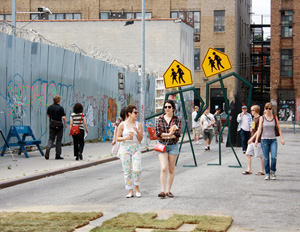
A whole other New York
The first weekend in June, more than one Brooklyn neighborhood holds a "self-organized, collaboratively produced arts festival." For a first timer, Bushwick Open Studios has surprises in store, not all of them on the walls. This is not the compact community of Soho long ago, the East Village around Tomkins Square Park back in the 1980s, a Chelsea arts walk of the 1990s, a simulated "Studio Visit" at Exit Art, or even Williamsburg, before gentrification pushed artists further east and further from Manhattan. Some of my favorite memories are of Dumbo's open studios, near the Brooklyn Bridge. Each year, I marched diligently down narrow industrial stairwells that now are turning to luxury co-ops. How could I not have written down more of those artist names, for work I may never see again?
Bushwick is a whole other New York. Studios scatter across three square miles, and one can walk four miles from Maria Hernandez Park to McCarren Park past Williamsburg without a trace of greenery. Nothing rises above a few floors, in an industrial landscape that even most Brooklynites may not know. Sheetrock walls show every sign of planned real-estate development—and not by the artists themselves. For more of a challenge, the L train was out of service, reducing visitors to packed shuttle buses and a long march in the heat. And yet they do come, with an audience for art inconceivable ten years ago.
Naturally they come to see artists' aspirations, along with word of mouth on restaurants. One finds more impulsive painting and small-scale sculpture than in the galleries. One sees that old battle between abstraction and realism that conceptual art and installation have largely pushed aside—but not only that. Oh, yes, I know that painter of twilight Brooklyn rooftops from an Upper East Side gallery. Could those fantasy kitchen parts have shown last summer in Dumbo's waterfront park? They did, and they look curiously less fantastic indoors rather than consigned to the scrap heap.
One finds something else as well, besides the dispersal of artists further into Brooklyn, just as others like Sarah Baley eye the Brooklyn Navy Yard. It is most obvious in the newest factory conversions, near the Morgan Avenue subway stop. The lofts look big, but artists are doubling, tripling, or even quadrupling up. While Chelsea galleries almost demand big work, to make an impression, these artists can hardly help working small. The handful of Bushwick dealers is smaller still. As for living in one's studio or exhibiting out of a live-in loft, forget about it.
Those beyond New York might not understand. How did this city get so distinct in its notion of an alternative space? The short answer is cost. People do not work from their garage or apartment because they do not have a garage and cannot afford a larger apartment. Art costs more, too, and so competitive a market brings constraints of its own. As Williamsburg has gentrified, say, many dealers no longer save enough to do without the walk-in traffic, the respectability, and the reviews—and many have given up or moved to Chelsea.
Conversely, artists and dealers cannot squat in their workspace, because of the law. As New York lost more and more of its retail and industrial space, it cracked down, with harsher zoning and harsher enforcement. Soho lofts were "grandfathered in"—as was a close friend, in the loft we converted together overlooking a topless bar in 1977, in what was then a bleak area north of Chelsea. As for Dumbo, it took a developer more than a decade after buying up most of it, before he could get zoning rights to have people live there. Of course, he immediately chased out the remaining artists. Oh, and my friend in Chelsea needed the space to raise a family, and he now rents a studio elsewhere.
The good, the bad, and the outer boroughs
I would love a day exploring Brooklyn anyway. While it seems criminal to single out any of two-hundred fifty artists by name, I liked especially a landscape by Lisa Kirkbride of what looked like red Ping-Pong balls on Popsicle sticks, Eileen Weitzman's fabric fantasy creatures between plants and animals, and several instances of painstaking drawing. Most of all, I enjoyed the few Bushwick galleries. One collaborative space, Norte Maar, was showing classy drawings, including Jack Tworkov. A half-hidden gallery, Privateer, had an international cast but Brooklyn themes. Ward Shelley continues his family trees of cultural history, and Joerg Lohse photographs precisely the vacant lots that galleries and studios could easily expel.
Pocket Utopia keeps to neighborhood artists, featuring assemblages of old vinyl and CDs by Maggie Michael. English Kills gets raunchier, including paintings of a girl with a gun by Tessia Seufferlein and of fornication by Jim Herbert, like the world's largest Dana Schutz. Holly Faurot and Sara H. Paulson stage something between dancing, mud wrestling, and painting. Andrew Ohanesian builds and destroys walls. Placed at a corner of the L-shaped space, they create structures within the gallery structure laden with an imagined history. Besides, the dealer was personally serving hot dogs.
NURTUREart has in no time become the area's oldest nonprofit. In fact, everything on view for the day echoes a changing, dreamlike landscape. The dream starts out on the street, where Kim Holleman has parked a trailer. Within it, she has set curving brick walls, around a pond and garden—as the punning title has it, a Trailer Park. In the gallery stairwell, Chris Hagerty projects a rotating escalator, like a moving fantasy from Piranesi. The light itself seems to climb.
The theme of model housing continues inside. James Reeder constructs a cross between lampshades and modernist housing projects. Holleman has another ecosystem, a "sand collection" under glass. Out back, Audrey Hasen Russell has a larger version, with a tower and pink grass made of foam insulation. On the fantasy side, Meg Hitchcock spins fluid curves of cut-and-paste text, like two-dimensional poetry. Rahul Alexander has psychedelic Color Bars, and Mike Estabrook animates The Good, the Bad, and the Remix, with what looks like the cast of South Park in place of Eli Wallach and Clint Eastwood.
Some show a Brooklyn more literally in transition. Jason Falchook's painterly photographs capture it at night, glowing and empty. Deborah Brown does something of the same in her painting of Summer in Stanhope Street. Scrapworm's cluttered images still look like real places, but solarized. A broken bicycle of fiberboard, by Jonathan Brand, might have fallen there. Josey Hale's tapestry boat might have rowed there.
The whole show gets a little too polite, almost like Rirkrit Tiravanija and his museum giveaways and "relational esthetics" after all. An hour later, after a long walk in the sun, I could barely picture utopias like these, even comic or busted ones. Brooklyn looks messier all over again on the way to a microbrew and a working subway. Can it still hold true alternative spaces—and can New York? I had seen enough nonprofit activity and enough creativity. I am less sure who can afford either one.
Take the L Train?
In its fifth year, with or without the MTA, the entire event is still a tribute to the "do it yourself" spirit—and a stubborn tribute at that. The handful of galleries still run to overstocked, themeless group shows. Norte Maar, for one, has a developed a dogged resistance to curating. Another, Factory Fresh, turned the alley behind it for the day into an "art park," devoted in equal parts to art and to Brooklyn. The weekend's Web site refuses to make choices, too, with its "390 shows ordered randomly." Just try to find a map without heading for the artist spaces dignified as "hubs," and then try to learn in advance what are hubs.
Clearly much of this is ideological. One can see it in the "art park," where sculptors adapted Warhol-style Brillo boxes and bright-red dice to its logos, cut grass to spell out KEEP ON THE GRASS, and (courtesy of Leon Reid IV) turned street signs into a 3D pedestrian shuffle. One can see it in the deliberate clumsiness at NURTUREart, another pioneer, where a handmade Godzilla "makes amends" by painting and finishing a wall. One can see it almost any night during the winter, when galleries refuse to coordinate openings. And I have questioned whether this version of alternative spaces presents real alternatives. Art needs filters, and artists need promotion beyond Facebook—or the echo chamber of Brooklyn galleries, L, and the Brooklyn Rail assuring one another just how cool they are.
Part, though, may be Bushwick. Maybe the MTA was trying to tell me that too, as it obliged me to walk for hours (and killed off my trip entirely for the Williamsburg and Greenpoint studios two weeks later). I could appreciate again how hard it is to transform (I shall guess) a dozen square miles into a neighborhood, even when the Brooklyn Museum celebrates "Crossing Brooklyn." Rather, it extends from one neighborhood around Bushwick Avenue, near where Famous Accountants has taken over a basement, to the low-income housing off Lorimer Street, near another newcomer named Spread Art. In between lie bleak avenues and warehouses, with barely a spot of green. It cannot so easily follow Williamsburg in taking over storefronts, moving into lofts, and gentrifying dive bars.
Does there become a tipping point, if not to gentrification, then to an entirely new model? Perhaps not, but Williamsburg is not doing all that well either when it comes to galleries. And this year's model represented something of an explosion. It even has an epicenter, at that broad triangle off Flushing Avenue with Factory Fresh, English Kills, and Storefront. Momenta is joining them, too, in one of several buildings with an incredible concentration of studios. As a default, at least when the L train is running, one could head right there—and if the galleries decide once again to keep mysterious hours, so be it.
In over four hours, I stopped by several artists reviewed here before. As ever, Tyrome Tripoli works scavenged plastic into something more colorful, Susan Hamburger merges period roms with political commentary, and Deborah Brown (who gave me a map and got me started) paints the area's eerie future. Storefront had a fine show of work on themes of blackness and printing, curated by William Powhida. As ever, too, artists may complain about the dominance of installations, but most studio artists still paint or sculpt, too often predictably so. But the explosion was real, and I saw everything from paper sheep to dreamy and funny videos of the action out in the streets. I hesitate to single out anyone by name amid the explosion and the wreckage.
As perhaps another turning point, Bushwick even managed both a Times review and, for once, a solo show. And they fell at the area's furthest extreme at that. At Famous Accountants, Matthew Miller paints hyperrealistic male faces. Like descendants of John Currin or Lisa Yuskavage, they have a nod to art history, but more attitude than warts or texture. But Brooklyn thrives on attitude, along with the festival of studios and an art park. The tenant upstairs watched over the gallery, while what I took for sound art accompanied it—because a couple of guitarists were practicing their licks in back.

Bushwick Open Studios for 2009 and 2011 ran the weekends of June 6. Artists that same weekend in 2009 welcomed visitors to Red Hook, a good seven miles to the south. NURTUREart held its "Bushwick Biennial through July 19, 2009. Portions of this article's basic history came at the request of a west-coast magazine and may thus sound simplistic to local artists and real-estate mavens. Related articles bring the Bushwick annual event into 2012 and then into 2013.